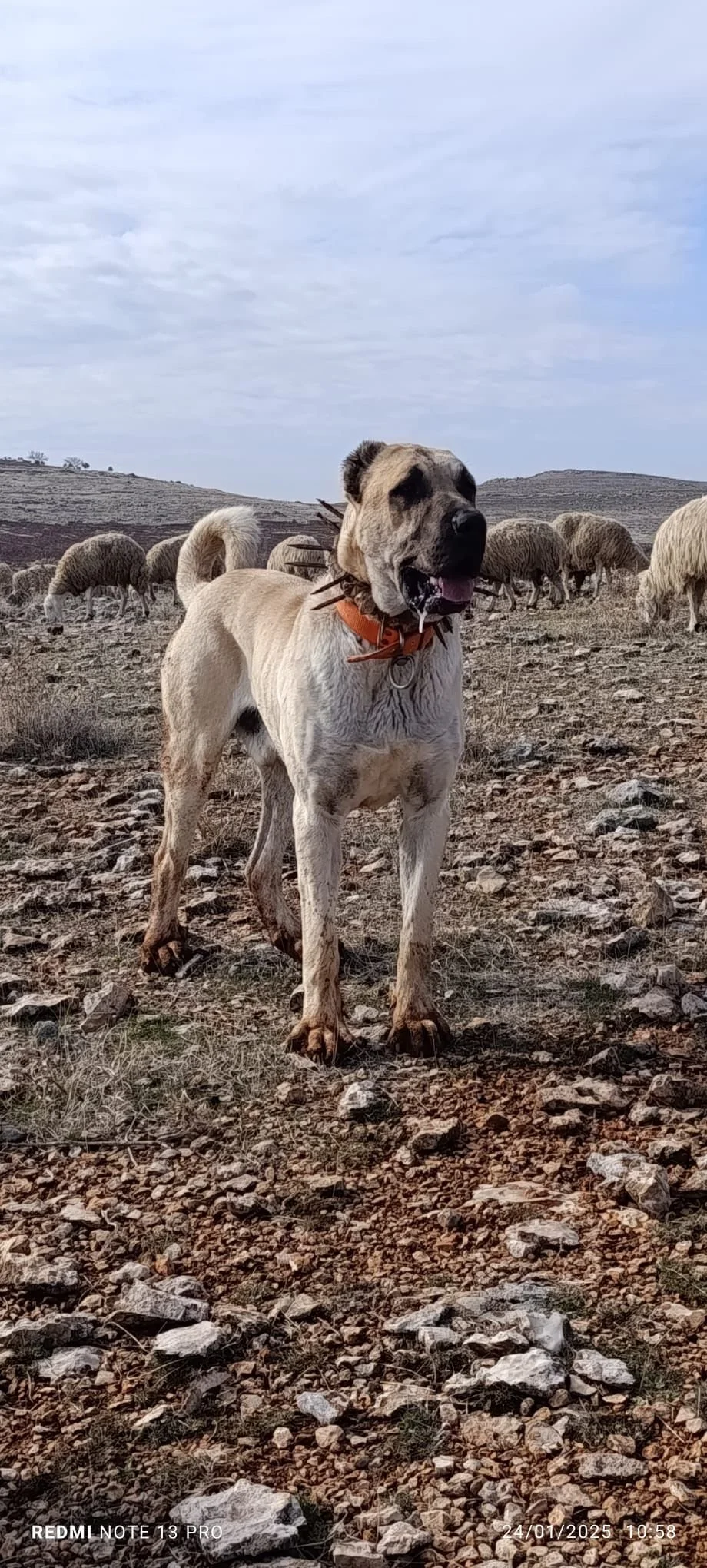
ORIGINS & HISTORY
The Turkish Boz Shepherd Dog originates from ancient livestock guardian populations that developed across southeastern Anatolia, shaped by geography, climate, predator pressure, and the practical needs of pastoral societies.
Long before modern breed names existed, shepherds in this region maintained powerful guardian dogs based on performance, survival, and reliability. These dogs were not bred for uniform appearance, but for the ability to protect livestock in some of the harshest environments on earth.
The Boz represents one of these ancient working populations.
Ancient Roots of Turkish Shepherd Dogs
For thousands of years, Anatolia has been a crossroads of civilizations, trade routes, and migrating pastoral cultures. Sheep and goat herding has existed in this region since antiquity, and large guardian dogs were an essential part of survival.
Dogs that failed to protect livestock were removed from breeding.
Dogs that demonstrated courage, endurance, and sound temperament were kept.
This functional selection created powerful landrace guardian populations rather than standardized “breeds” in the modern sense.
The Boz Shepherd Dog descends from this system.
Southeastern Anatolia as the Core Region (Şanlıurfa)
The heartland of the Boz Shepherd Dog is southeastern Anatolia, particularly the Şanlıurfa region.
Şanlıurfa has long been a center of pastoral livestock culture, with constant exposure to:
• Wolves
• Jackals
• Bears
• Human theft and conflict
• Extreme heat and cold
Dogs in this region were required to be large, physically dominant, mentally stable, and capable of independent decision-making.
Boz-type dogs developed here as heavy-boned, powerful guardians with substantial mass, thick skin, and strong defensive instincts.
This region remains one of the most important sources of true Boz-type working dogs today.
Nomadic Cultures and Phenotypic Diversity
Turkish livestock guardian dogs did not develop inside closed kennel systems.
They developed inside moving, nomadic, and semi-nomadic pastoral cultures.
Different tribes and shepherd groups maintained dogs based on what worked for their terrain and predator pressure. This created phenotypic diversity within a shared functional type.
The Boz Shepherd Dog represents a heavier, larger, more massive guardian phenotype within this broader Turkish working dog population.
These dogs were never bred for show rings or cosmetic uniformity.
They were bred to survive and work.
Variation existed, but function remained consistent.
Migration Routes: Urfa → Malatya → Central Anatolia
Boz-type dogs historically moved along livestock migration corridors.
One major route extended from:
Şanlıurfa → Malatya → Central Anatolia
As shepherds moved seasonally with their flocks, their dogs moved with them. Over time, Boz-type dogs established presence across these regions while maintaining their core structural and functional characteristics.
This migration explains why Boz-type dogs can be found in multiple provinces today, while still tracing back to southeastern Anatolia as their primary origin.
Why Boz Are NOT Yoruk Dogs
Earlier assumptions often associated all large Turkish guardian dogs with Yoruk (Yörük) nomadic groups.
However, Boz Shepherd Dogs are not specifically Yoruk dogs.
Boz-type dogs are more closely tied to southeastern Anatolian pastoral cultures centered around Şanlıurfa and surrounding regions, not exclusively to western or southwestern Yoruk migration routes.
This distinction is important for accurate historical understanding.
Why Some Types Were Fixed Later (Kangal Example)
Certain Turkish guardian phenotypes, such as the Kangal, became more standardized much later through regional promotion, government programs, and export focus.
Before this, Turkish guardian dogs existed as overlapping working populations rather than rigid breeds.
The Boz represents an older, broader working population that predates modern fixation efforts.
The fact that some phenotypes became standardized later does not mean other populations did not exist.
It means modern breed labels were applied long after these dogs had already been working for centuries.
Living History
The Boz Shepherd Dog is not a recreated breed.
It is a living continuation of ancient working dogs that still exist in rural Turkey today.
TBR’s mission is to document, preserve, and protect this living genetic heritage before it is lost to uncontrolled mixing, commercialization, and misinformation.
The Boz survives because it still works.